


 Posts
Posts


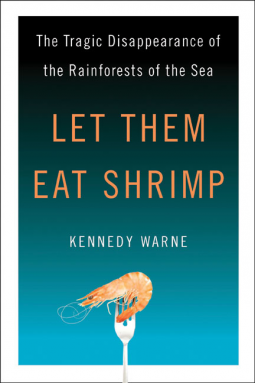
The title aside, “Let Them Eat Shrimp” by Kennedy Warne is
about mangrove ecosystems and the threats facing them. While not an exhaustive
natural history of the mangrove trees, and saying very little about the shrimp
themselves, this is an important, big picture of the role mangroves play in
protecting our world. I was reminded, though not thematically, of “The Underground Girls of Kabul” for the excellent journalism investigating and
reporting this subject. The author, traveling, is part of the story but only as
one human element – the book is not about him. Nor is this the typical
depressing read on the subject of environmentalism (or human rights). This is a
report of how we benefit with mangroves in mutuality, not just the consequences
of their destruction but some of the solutions for improving their outlook.
One of the first stops is in Bangladesh, the long-protected
Sundarbans, with a natural abundance including home to tigers and their prey. However,
shrimp fry are caught there in fine-meshed mosquito nets that leave 99% of the
bycatch to waste, to stock the abutting shrimp ponds. This poses an economic problem as well – there
are practically no alternatives for the people who live there. In Brazil,
shrimp farms’ salinity ruins the people’s drinking water and farmlands, but as
elsewhere, are not the only threat – eucalyptus tree farming was already there.
The introduced business of shrimp farming contrasts with artisanal fisheries,
including collection of mud crabs, or, in Ecuador, gathering of cockles. These
are areas of economic poverty and environmental racism. Guards from the shrimp
farms even shoot at anyone that gets near the facilities – even though they're
not stealing, just trying to earn a living as they had before. Fast profits
from this industry, as with golf courses and other man-made structures, do more
long-term damage than good; the mangrove forests were already central to the
homes and livelihoods of the people who live with them. Shrimp seem like an
obvious excess to cut out, which is why I guess the book is titled as it is.
The second half or so is less about shrimp farming and more
about the need for mangrove conservation in general. The author went to Bimini
in the Bahamas, where Martin Luther King Jr. went to write speeches, including
his last, and Ernest Hemingway went to fish and shoot to kill sharks (he
misunderstood them). A shark research and conservation center has been set up
there; like other species, they use the mangroves as nurseries. Warne also goes
to Belize to see the various components of a dwarf mangrove ecosystem,
including many unique invertebrates that play their own functions. The dwarf
trees have evolved to function at that size, and though they are efficient at
taking up nutrients, the trends of excess are toppling these botanical
treasures. With the same biocomplexity specialist, he goes to Panama, returning
there at the end. Charcoal from mangrove poles is a big use, but in a place where
garbage is choking up the waters, they are at least striving for a sustainable
harvest of this fuel source. He turns to Malaysia to cover carbon sequestration
and the undervalued role of mangroves; to Florida, where restoration is
underway; and Eritrea, which is proving to be a success story of working
against poverty.
Meeting with world experts, both scientists and community
members, we get a clear sense of the importance of mangroves (which the author
thinks of as an “underdog”) in the health of the globe itself. In terms of restoration,
which is more than simple reforestation, abandoned shrimp ponds are good
candidate sites (and also account for so much of the loss). Propagules, the
seeds or seedlings of these trees, are mentioned, but a little hard to picture;
having color photos included is a bonus, but as stated above, this isn’t
in-depth natural history of any one organism. Providing area in hectares as
well as acres helps to get an idea of these sites whichever way works best for
you.
I did not know much about mangroves, but have a much greater
appreciation for them now. They are also essential coastal protection and buffer
zones, and provide so many benefits to so many: directly for people living by
them, more subtly for the rest of the world. This book was published in 2011,
so I wonder how things compare five years later, especially with regards to
climate agreements. My review may be overdue, but this book is just as
relevant now, and one of the best I have read in this category. Read, learn more
about mangroves, do what you can to save and restore them.
Note: I received this book courtesy of Island Press in
exchange for an honest review.
“Ya secaron el
manglar, ya entubaron la laguna.”
-Malpaís, “Coplas del
Cusuco”
La Canción de Adán (2009)

No comments:
Post a Comment